
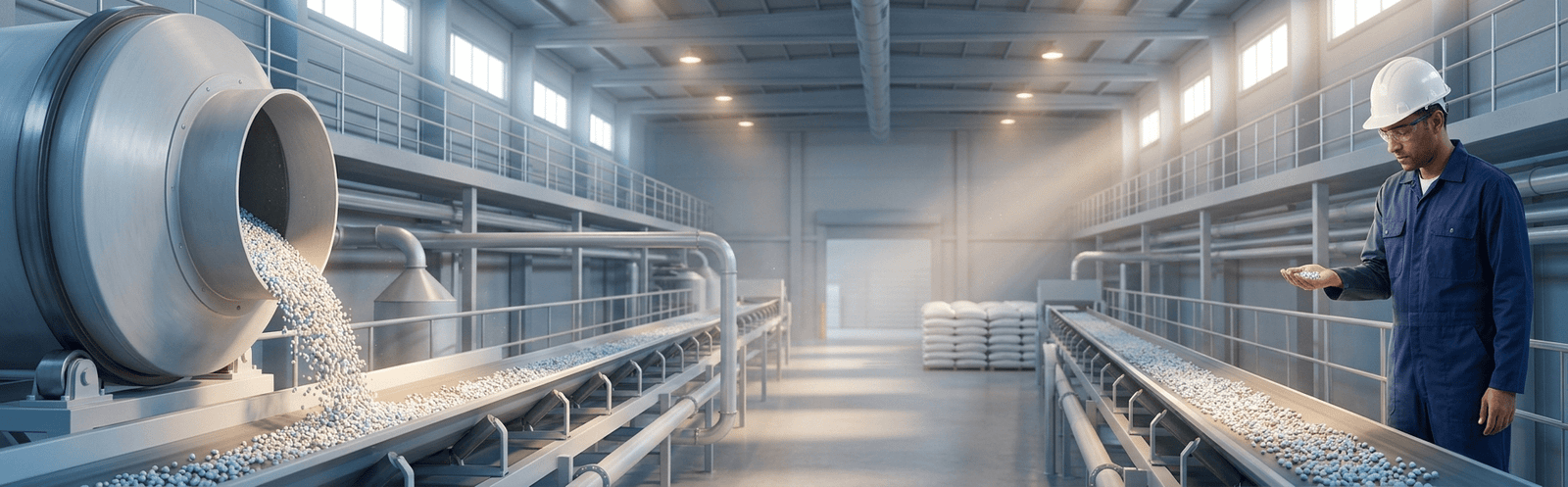
How we make our fertilizers
Crop & Agronomy Knowledge
How We Make Our Fertilizer at The Gate
Every bag of fertilizer that reaches your field has already completed a long journey, one that starts with elements found in nature and ends with a precisely engineered product designed to give your crops exactly what they need. We do not simply manufacture fertilizer; we build a complete nutritional system for the plant, from raw material selection all the way to the soil.
Where the core nutrients come from
Captured directly from the air and combined with hydrogen to form ammonia, the foundation of most nitrogen-based fertilizers.
Sourced from natural phosphate rock, mined from ancient geological deposits.
Extracted from potash salts formed in ancient seabed deposits, rich in the element crops need for stronger roots and better stress resistance.
From reactor to field: the production journey
- Formation reactionNitrogen captured from the air reacts with hydrogen under high temperature and pressure to produce ammonia.
- Chemical processingAmmonia is converted into core building blocks such as urea, ammonium nitrate and nitric acid.
- Crop-specific tailoringEach ingredient is fine-tuned to match specific soil and crop needs, because no single fertilizer fits every field.
- Final formulationThe blend is shaped into its final form, granules, powder, liquid or suspension, depending on how it will be applied in the field.
Multiple forms for every agricultural need
| Form | Characteristics | Best suited to |
|---|---|---|
| Granules | Solid, uniform particles with gradual nutrient release | Direct soil application |
| Powder & liquid | Fast-dissolving, enabling rapid nutrient uptake | Fertigation and foliar spraying |
| Suspensions | Fine particles that remain undissolved | Foliar application and seed coating |
Which form suits your operation depends largely on your irrigation infrastructure, a decision covered in detail in our comparison of water-soluble and granular fertilizers.
Quality is not a slogan, it is a daily discipline
We know that even a small error in a fertilizer formula can cost a farmer an entire season. That is why every production batch goes through:
- Precise nutrient concentration checks before packaging
- Impurity and heavy-metal testing, kept well below internationally accepted limits
- Physical property testing, density, shape and strength, to ensure even field distribution and prevent caking during storage
Our environmental responsibility
Fertilizer production consumes energy, that is a fact. The real question is how to reduce environmental impact without compromising product quality. We focus on:
- Cutting carbon emissions across our production lines
- Optimising energy use during chemical reaction stages
- Developing lower-carbon formulations without sacrificing effectiveness
The wider shift behind this work, and what it means for producers exporting into carbon-priced markets, is covered in our article on green ammonia and fertilizer production.
Manufacturing is not the finish line
Our role does not end once the fertilizer is made, it extends to helping farmers use it correctly. That is why we provide precise guidance on timing and dosage for each crop, maximising benefit and minimising waste. Even the best fertilizer loses its value in the wrong hands.
From the reactor to your field
Talk to our team about which formulation and form fit your soil, your crop and your irrigation system.
Get in touchRelated: Crop nutrition · Why is fertilizer important · NPK fertilizers explained


